
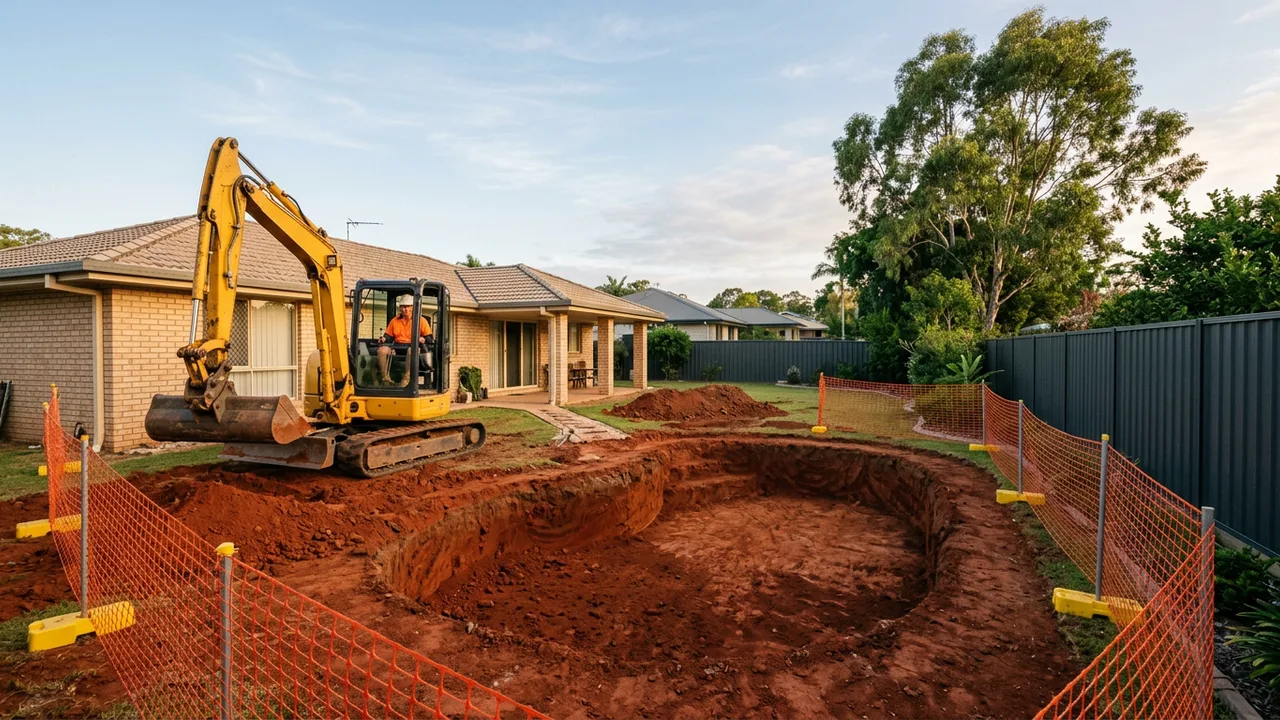
Pool Excavation in Toowoomba
The pool is ordered and the hole has to be dug through clay, maybe rock, and a backyard gate. A pool dig goes smoothly when the machine route and the spoil are planned first.
Two things set the price of pool excavation in Toowoomba: what is in the ground and how a machine gets to it. Some Toowoomba blocks hold rock, some have clay that fights the bucket, and some fall away enough that the pool has to be cut into the hillside. A contractor who looks at your block first can price the dig against the soil and the access you actually have.
Pool excavation in Toowoomba: what the dig involves
A pool dig is a deep, shaped hole cut to the pool builder's levels. The excavator is a tracked digging machine, sized to fit the way into your yard. A small machine fits through a narrow gap but digs slowly. A larger one finishes sooner but needs a wider path.
The soil matters as much as the machine. Moisture levels change how clay digs: after a wet week it sticks to the bucket and smears on truck tyres, so a dig is often pushed back a few days rather than forced.
Slope adds another layer. On a sloping block, the pool position can sit well above or below the street, which changes where the machine enters and how the soil leaves.
Rock, roots and buried services
Rock is the biggest worry for most owners, and a fair concern. If the dig hits rock, the machine may need a hydraulic breaker, which is a hammer attachment that shatters it. That takes longer and costs more than digging soil, so a pool contract usually carries a rock allowance: a set rate for whatever is found, agreed before digging starts.
Old footings or buried rubble inside the pool outline come out with the dig. For roots just outside it, the pool builder can say which ones need cutting back so they do not lift the shell. Buried services such as water, sewer, power and stormwater lines can sit where you least expect them, and a careful contractor locates them before the bucket goes in.
Excavator access and spoil route
Machine access comes down to the narrowest gap between the street and the pool position. Side gates, fences, retaining walls, sheds and overhead lines all narrow the path. A machine on a steep side access needs a safe, stable run.
The spoil route is the other half. A pool hole creates many truckloads of soil, and each load has to leave the property. If trucks cannot reach the back, a smaller machine may move the soil to a loading point near the street.
A narrow side gate usually means a smaller machine and a longer dig, and that shows up in the price. Some quotes cover only the digging and leave the carting to you, so spoil removal deserves its own line.
Protecting your lawn, driveway and fences
A pool dig will mark the yard along the machine's path, and a good contractor plans to limit it. Ground protection mats, a set route and neat loading keep damage down. Concrete drives and pavers cope with truck loads better when the route avoids edges and drainage grates.
Some lawn repair is normal once the pool is in. What gets restored and what the pool builder or landscaper finishes later is worth settling early.
Variations and written approval
When rock or an unmarked pipe turns up, the scope changes and so does the price. That change belongs in writing before the extra work starts. Queensland domestic building work over $3,300 needs a written contract, and a clear paper trail protects both you and the contractor.
The QBCC register lets you look up your contractor's licence yourself, and it is worth doing before you agree to the job.
Hiring an excavation contractor directly or through the pool builder
Some pool builders include the dig in their price and use their own excavator operator. Others leave it to you. If the dig is separate, an independent earthworks contractor quotes it on its own, and trenching and spoil removal can often be priced in the same visit when they are listed on the quote.
The contractor works from the pool builder's levels and timing, and the pool builder needs a clean, correctly shaped hole. Naming your pool builder and the shell size keeps the dig matched to the pool.
Shell ordered and the side gate is tight? Type the gate width, the slope, your builder's dates and whether the shell is fibreglass or concrete into the message, then request a project review so the dig is priced against your actual access, rock and spoil.
How it works
-
Look at the block
The contractor walks the yard to see the slope, the gate widths, the trees and where the pool will sit.
-
Price in writing
The contractor quotes in writing before any machine arrives, covering the dig, the machine route and the spoil removal.
-
Set out and dig
The excavator cuts the hole to the pool builder's levels, working from the planned access route.
-
Cart off the spoil
Trucks or bins take the soil away as the hole deepens, so the yard stays workable.
-
Hand over to the pool builder
The finished hole is trimmed and ready for the shell, then backfilled once the pool is in.
Scope in detail
- Cutting the pool hole The excavator digs to the depth and outline your pool builder has set out, with room around the shell for working and backfill.
- Rock breaking and broken rock If rock needs a hydraulic breaker, breaker time and carting of the broken rock are worth seeing as separate lines on the quote.
- Trees close to the dig A large tree near the pool position may need an arborist's view before the machine starts, because heavy root cutting can harm the tree.
- Bins or trucks for spoil Bins suit a yard where a truck cannot reach the back, while trucks suit open access. Clean soil can sometimes be reused for levelling elsewhere on the block.
- Trenching for pool services Plumbing and electrical runs to the pool equipment often need trenches dug across the yard.
Swimming pool excavation options
- Fibreglass shell digs A hole cut close to the shell's shape, with a little extra depth for a levelled bedding layer and modest room to backfill around the sides.
- Concrete pool digs A hole sized to the dimensions and working space the pool builder specifies for the chosen construction method.
- Reading a rock allowance The line on a quote shows whether rock is charged by the cubic metre or by the hour, and whether carting the broken rock away is included.
- Spoil removal and backfill Carting the dug soil off site, then returning suitable material around the shell once the pool is in.
Swimming pool excavation across Toowoomba
Frequently Asked Questions
How long will my pool dig take for a small pool versus a large one?
How soon can a contractor start my pool dig?
Should a variation on a pool dig be agreed in writing before the extra work starts?
Get it priced
Block not level or ground in the way of your build? Tell us about the job and get it moving.
Share the details and we will help you take the next step with confidence.