Earthworks in Middle Ridge for Large Family Blocks
You can level a sloping Middle Ridge block without losing the trees and lawn you want to keep. The job goes best when the operator plans the dig around those trees and shapes the pad so it drains.
Planning earthworks in Middle Ridge starts with the machine's path, set before the first cut on a big garden. How the ground falls and where the house sits decide where the pad, driveway and any wall can go.
Earthworks in Middle Ridge: what changes when the block is big
On a large block, every job stretches over more ground. A house or shed pad has to sit at your builder's heights while the land falls away around it. A long driveway has to shed water along its whole run, not just at the gate. A trench for a plumber or electrician can cross a lot of lawn, and a pool dig leaves a big volume of soil that has to go somewhere.
A bigger block gives you room to work, but it also gives the ground more distance to fall. A contractor with an excavator, a loader and a roller can do the cut, the fill and the final grade in one run. That keeps the levels consistent from the house site down to the driveway.
The first visit matters. The contractor looks at how the ground falls, what sits in the way and how the machine will get in. Your quote then fits the land in front of them rather than a guess from a street address.
How does an excavator work around trees and lawn?
Protection starts with the plan, not the machine. Before digging, the contractor pegs the machine's path and flags each tree that stays. Roots spread well past the canopy, so cutting or burying ground close to a trunk can harm a tree that looks untouched for a season or two.
Lawn is easier to save when the machine uses one set path in and out. Heavy turning on turf leaves ruts, so operators often lay boards or keep to a single track. Topsoil is worth stripping and stockpiling separately, because it can go back on the finished levels and give the lawn a start.
Some turf damage cannot be avoided on a big cut, so the contractor marks where it is likely before work begins.
Retaining walls and concrete sleepers on a slope
A sloping block often needs a retaining wall, and the wall needs a cut into the hill first. The contractor excavates a bench for the base, sets the footing line and leaves room behind the wall for drainage gravel. Without that drainage, water builds up behind the wall and pushes on it.
Concrete sleepers are a common choice for a larger garden. They stack between steel posts and suit long, straight runs across a sloping garden. Taller walls can need engineering sign-off, so the height you want is worth raising with a building certifier or council early.
Accuracy matters because every sleeper sits on the bench below it. If the bench is cut low, the whole wall line drops with it. Surplus soil is carted away so the garden is usable again.
Pads, drainage and driveways that hold up
A level pad only helps if water leaves it. The surrounding ground is shaped so rain runs away from the slab and the shed rather than pooling against them. Where the fall is gentle, that might mean subtle grading. Where it is steep, a swale or a drain may be needed.
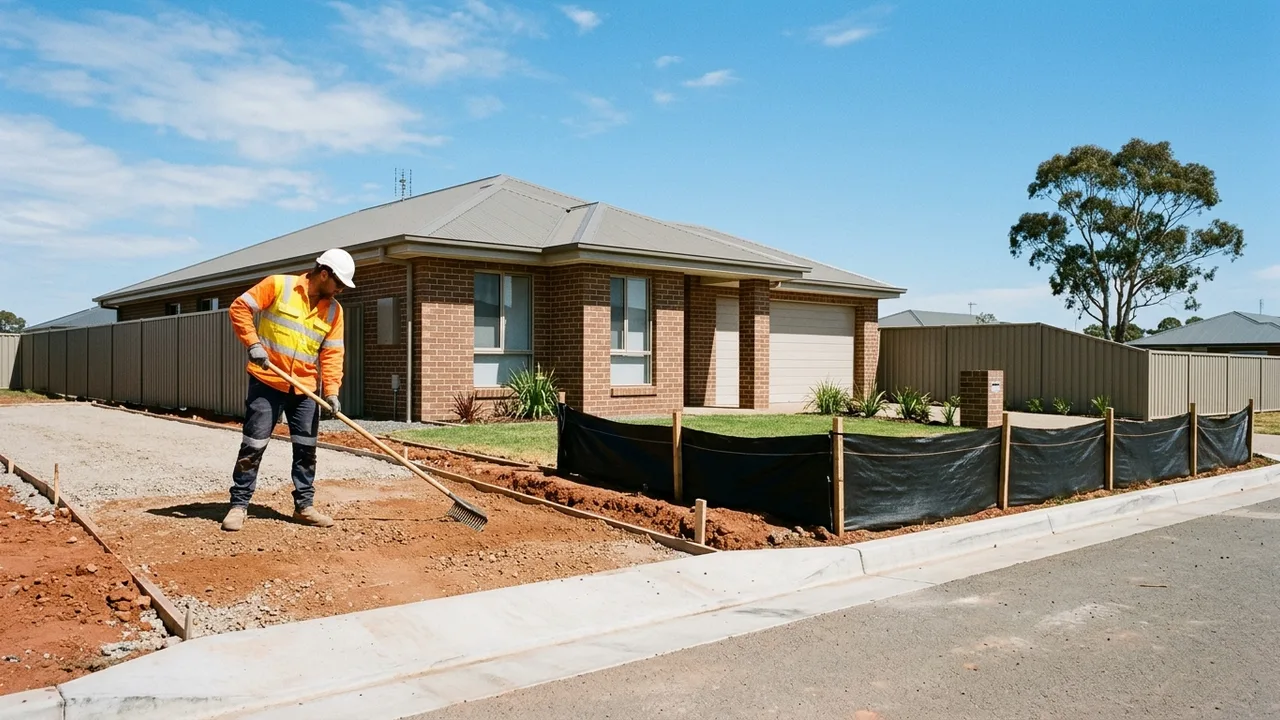
Driveways on a rise need the most thought. A washed-out base usually means the fall sent water down the middle of it. A new base is cut to shed water to the sides, compacted in layers and sized for cars and the occasional truck.
Footing and slab digs run through Toowoomba clay and rock, with the machine route planned around established gardens on larger Middle Ridge blocks. The quote sets the agreed scope for the work.
What Middle Ridge streets and ground mean for the job
Middle Ridge sits high on the range on Toowoomba's southern side, so a block near Toowoomba Golf Club or Middle Ridge State School can fall away from the street. On the steeper ones that fall changes how a wall is cut, where a pad can sit and how it drains. The contractor reads it on site.
Many Middle Ridge homes sit on big, established blocks, so the machine route often has to pass mature trees and lawn the owner wants kept. Ramsay Street and the Gabbinbar Homestead estate are associated with established housing and leafy settings. On blocks nearby, trees along a side boundary can block the usual side access, so the machine may have to cross the front lawn to reach the back garden.
On the steeper streets, a loaded tipper may need to stand at the kerb rather than in a sloping driveway. That changes how many loads the dig takes and how far soil has to be moved by machine across your lawn.
Sloping block, a wall to cut or a driveway that keeps washing out? Say which way your Middle Ridge block falls, which trees stay and what you want built. That is usually enough to tell a bench-and-wall job from a simple cut and fill.
Services in Middle Ridge
- Retaining wall excavation The cut, set-out and drainage room behind concrete sleeper or sandstone block walls on sloping blocks.
- Trenching Trenches for stormwater, water and power dug to depth and line, with the yard around them left tidy.
- Swimming pool excavation Pool digs planned around machine access, rock and clay, with the spoil trucked off your property.
- Yard clean-up and spoil removal Leftover soil, rubble and spoil removed from the yard and carted off by tipper truck after the dig.
- House and shed pads Pads cut, filled and compacted to the levels your slab or shed needs, on suburban and rural blocks.
- Site preparation and levelling Topsoil stripping, rubble removal, cut and fill and grading take a block from rough ground to build-ready.
- Excavation and footings Footing and slab digs through local clay, rock and old fill, including blocks with tight side access.
- Driveway earthworks Driveways shaped, drained and laid with road base, gravel or bitumen so they stop washing out in storms.
Frequently Asked Questions
Which licence class does an earthworks contractor need in Middle Ridge?
Get it priced
Block not level or ground in the way of your build? Tell us about the job and get it moving.
Share the details and we will help you take the next step with confidence.