
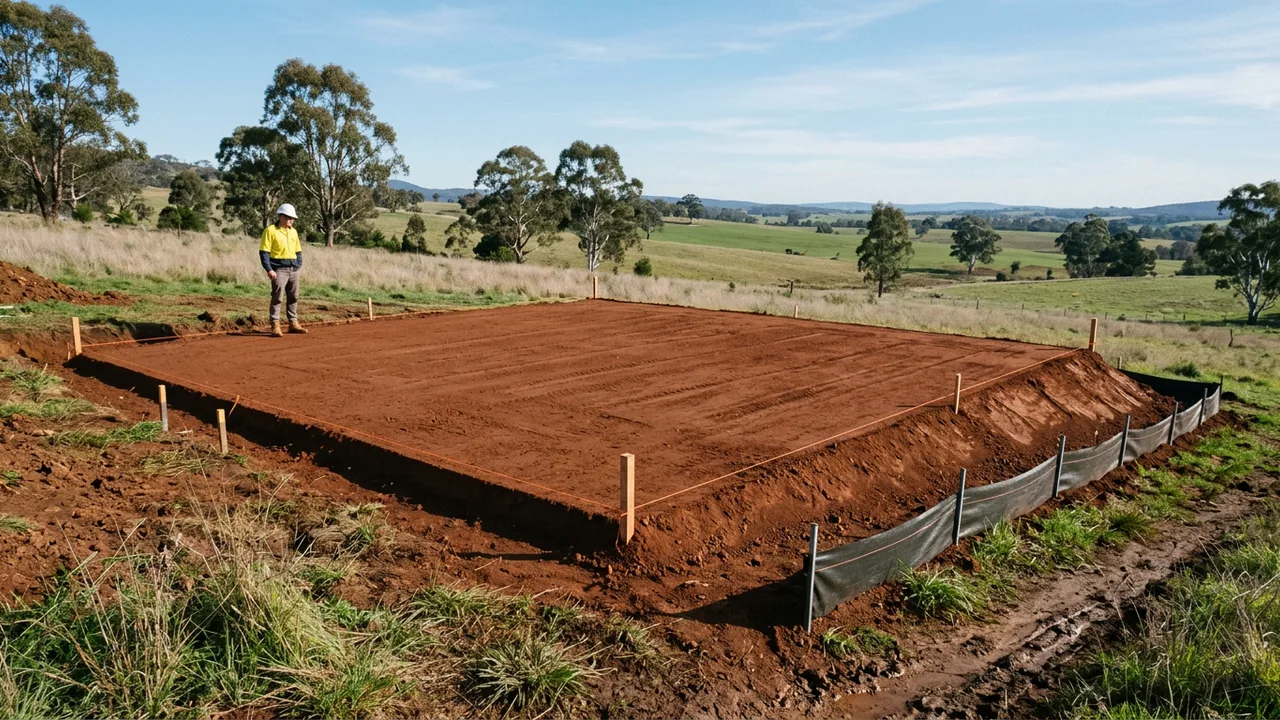
House Pad Earthworks in Toowoomba
The slab date is set, or the shed is ordered and nowhere is flat. A house pad is cut, filled and rolled until the ground is level and firm enough to pour on.
A house pad earthworks job in Toowoomba builds the platform your slab sits on, level, compacted and at the heights your engineer and builder have set. Clay, rock and sloping ground all come into it, and a block that falls away usually needs a cut on the high side and compacted fill on the low side, which the contractor confirms on site. Done properly, the concrete crew turns up to ground that is ready and stays put for years.
House pad earthworks in Toowoomba: who sets the levels for your pad
Your engineer and builder set the finished levels, and the earthworks contractor builds the ground to match them.
That is why rework hurts. The plumber cannot lay pipes and the slab crew cannot pour until the pad is at the right height, so a pad that is out by a few centimetres holds up every trade behind it.
Blocks on a slope or on reactive clay usually need a mix of cut and fill. The soil report decides how carefully that fill is placed.
Cut, fill and compaction on a sloping block
On a sloping block, the depth of cut on the high side decides how much fill the low side needs, and every tonne of difference is either a truck out or a truck in.
Compaction is what makes filled ground trustworthy. Fill goes down in thin layers and is rolled each time, because a thick loose layer settles later under the slab. Where the engineer calls for it, compaction is tested and the results are kept, so the builder holds a record that the pad matches the design.
Cut ground is usually firmer than fill. A slab that sits half on each can settle unevenly, so operators often cut deeper and rebuild that part with compacted fill. If the soil report shows reactive clay, that care matters even more, because clay holds water and moves with the seasons.
Shed pads and house pads: what changes
A shed pad needs the same attention to levels, drainage and compaction as a house pad.
The pad is built wider than the shed. That keeps the edges of the slab off the sloping side of the fill, called the batter, where soil is most likely to crumble.
A shed that will hold a loaded truck or heavy machinery needs a thicker, better-compacted pad than a garden shed. The same contractor can often build both, along with the driveway or retaining wall needed to reach them.
Why the ground has to hold the slab through wet and dry years
Engineers call it bearing capacity: how much weight the ground can carry before it moves. It depends on the soil underneath and on how well the fill was rolled.
Moisture levels matter twice. Fill compacts best at the right dampness. Too dry and it will not bind, too wet and it turns spongy. Later on, clay soils swell when wet and shrink when dry, which is why slabs on clay are designed by an engineer.
In Queensland, the builder must get foundations data suited to the site before a home building contract is signed, unless suitable data already exists and can reasonably be relied on.
What drives the cost of a pad
The price follows how much soil moves, where it goes, what the machine hits and how many hours it runs.
Volume is the biggest driver. A steep block with a large cut and a long haul to a tip costs more than a gentle fall where the soil is simply shifted across the pad.
Setup matters too. Getting machines to site, setting out the levels and any compaction testing can sit inside the price or be added on top, so it pays to know which.
Rock, old pipes and tight access
Rock is the ground condition that moves a pad price most. A look at the block shows where it is likely to sit, and a good quote states how rock is charged if the machine hits it.
Old pipes and buried rubbish add digging time, so the contractor looks for them on the walk-through. A good written price also states how much cut and fill is allowed for and how extra volume is charged.
For a tight backyard, the contractor should check the access width before choosing machinery. On larger blocks with open access, bigger machines move more soil per hour.
Licence and contract before the machines arrive
Larger domestic building work in Queensland needs a written contract, so the price and scope are on paper before work starts. You can also look up a contractor's licence on the QBCC register.
Slab date booked and the block still on a fall? Give the slope, the access width and the soil report details, and Request a Project Review to get the pad priced before the concreters are waiting on it.
How it works
-
Look at the block
The contractor walks the site, reads the plans and checks the slope, access and soil before pricing the job.
-
Set out and strip
Pegs or a laser mark the pad corners and heights, then the topsoil is stripped back.
-
Cut and fill
The excavator shapes the ground and moves soil from high to low until the rough levels are right.
-
Compact and finish
Fill is rolled in layers and trimmed to final level. Testing and photos are done where the engineer calls for them.
Scope in detail
- Topsoil strip and rubble removal Organic soil rots and shrinks, and old rubble hides soft pockets, so both come off before any fill goes down.
- Cut and fill to design levels Soil moves from the high side of the block to the low side so the pad balances.
- Layered compaction Rolling thin layers makes the fill dense enough to carry a slab without settling.
- Spoil removal and imported fill Extra soil leaves site and any shortfall is made up with suitable material.
- Grading for drainage A slight fall around the pad sends rain away from the slab edge.
House and shed pads options
- House pads Cut, fill and compacted platforms built to the levels on your plans, ready for the plumber and the slab crew.
- Shed pads Level, firm and drained bases for sheds and workshops, sized so the edges are not sitting on loose ground.
- Grading and site preparation Topsoil stripping, shaping and falls across the block so water leaves the building area.
House and shed pads across Toowoomba
Frequently Asked Questions
Should an earthworks contractor visit my block before quoting a house pad?
What are the main types of earthworks for a house or shed pad?
What problems can a poorly built house pad cause?
Get it priced
Block not level or ground in the way of your build? Tell us about the job and get it moving.
Share the details and we will help you take the next step with confidence.