Driveway Earthworks in Toowoomba
A driveway that ruts, bogs or washes out every storm has a water problem first. For driveway earthworks in Toowoomba, the fix is to send the water somewhere else and put a proper base underneath.
Fixing a washed-out driveway starts with changing where the water goes, because a driveway fails when water runs down it instead of off it. The work is to reshape the surface, build a compacted base and give storm water a path off the driveway. Getting the fall and base right reduces washouts and helps gravel, road base or bitumen hold up under traffic.
Driveway earthworks in Toowoomba: why driveways wash out
Rain lands on the driveway, runs along it and picks up speed. By the bottom it carries away fines, the small particles that bind gravel together, and leaves ruts, bare clay and loose stone.
On a sloping Toowoomba block that falls toward the street or a gully, runoff from the lawn or paddock above the driveway joins the rain landing on it, so a storm sends the whole slope down one strip. The clay underneath turns slick and soft when wet, so a thin or uncompacted base sinks under every car while the water races down its length.
Topping up with fresh gravel rarely lasts. If the shape and drainage stay the same, the next storm cuts the same channels. The contractor confirms the cause on site.
Grading, site preparation and road base
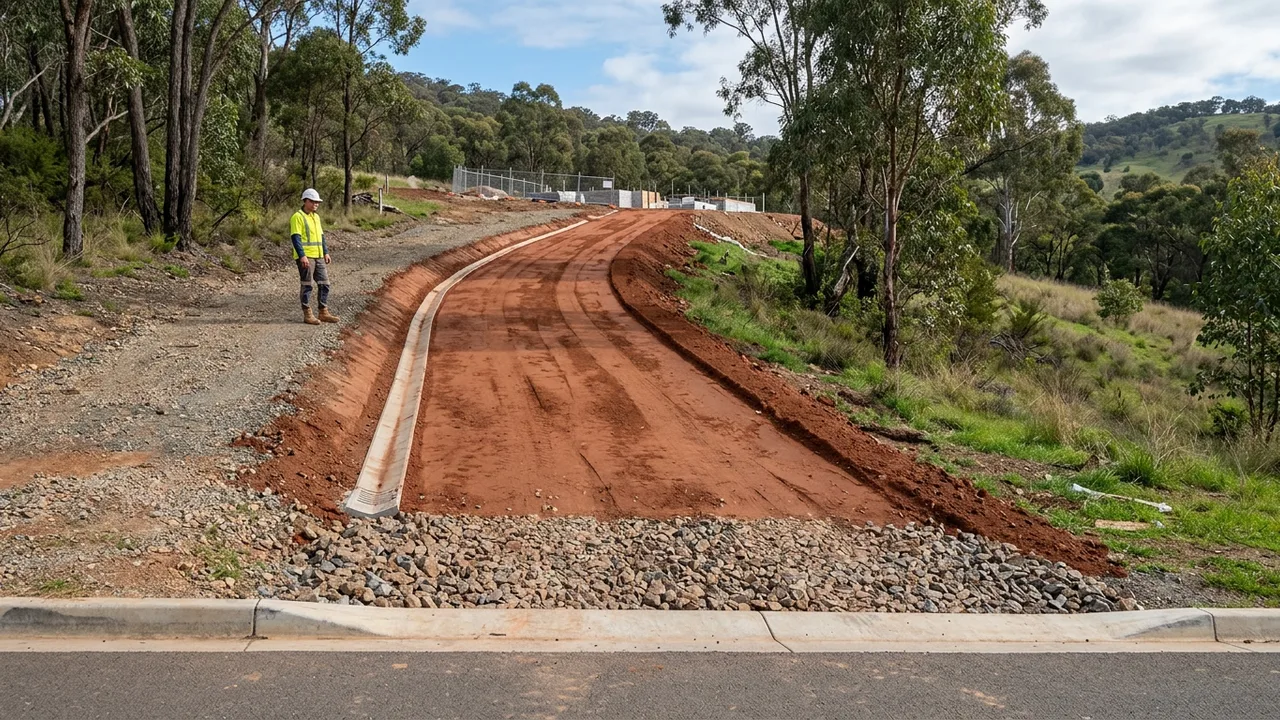
The job starts with grading and site preparation. That means cutting and filling the driveway to a consistent grade, with a gentle crown in the middle or a cross-fall to one side so water sheds off.
Next comes the base. Road base is crushed rock that locks together when it is laid in layers and compacted with a roller. Skipping the compaction gives a driveway that looks good for a month and then sinks into wheel tracks.
Drainage goes in alongside. A cross drain is a pipe or channel that carries water under or across the driveway. A table drain is a shallow ditch along its edge. Placed well, they send runoff to a safe spot.
Gravel, road base or bitumen: which suits your driveway?
Gravel is a common choice for long rural and acreage driveways. It is easy to top up, and it needs the odd regrade as it wears.
Bitumen and asphalt give a sealed, tidier finish closer to the house. They need a firm, well-drained base, because water getting under a sealed surface lifts and cracks it.
On soft clay, a stabilised base can be worth considering. A binder is mixed into the ground so it stops turning to mud in the wet.
The right surface depends on your slope, drainage and traffic, so the contractor can weigh gravel against a sealed finish once they have seen the driveway. Whichever surface goes on top, the base underneath does most of the work.
Steep, narrow and acreage driveways
A steep driveway can be built, but the grade, the drainage and the surface all work harder on a slope. Bare gravel on a steep run washes out quickly. Cross drains at regular spacing break up the flow, and bitumen or a stabilised surface often holds better than loose stone.
Smaller excavators and bobcats fit through many side gates and narrow side yards, so tight access does not always rule out the work.
On acreage, driveways run long and cross gullies or paddocks. The work there is as much about drainage and culverts as the surface. Whether it is a short town driveway or a long rural entry, the same rule holds: water has to leave the surface.
What drives the cost of a driveway job
Length, width, slope and the state of the ground set most of the price. A long driveway needs more material and machine time. Rock or old buried pipes add work, which is why a written quote should spell out what is included.
A good quote also says how rock would be priced if it is found. That way the agreed scope is clear to both sides from the start.
Hiring a contractor for a driveway job
A good contractor looks at the driveway during or after rain, because that is when the fault shows. They talk about drainage and base depth, not just the surface.
In Queensland, larger domestic building work needs a written contract, and a contractor's licence can be looked up on the QBCC register. Both are worth having before work begins.
Driveway rutting or washing out after every storm? Give the length, how it falls and what drives on it, and the drainage and base can be priced together. Request a Project Review.
How it works
-
Walk the driveway in the wet
The contractor looks at where water arrives, where it gathers and where it carves out the surface. That tells them what the job needs.
-
Strip and reshape
Soft, worn material comes off and the driveway is cut and filled to the right grade, with a fall that sheds water.
-
Fit drainage
Cross drains, table drains or pipes go in where runoff needs to cross or leave the driveway.
-
Build and compact the base
The base goes down in layers and each one is rolled before the next, so a loaded ute or a delivery truck does not sink it.
-
Finish the surface
Gravel is spread and dressed, or the base is prepared for bitumen or asphalt to be sealed over it.
Scope in detail
- Reshaping and levelling Cutting and filling to a consistent grade lets water leave the surface before it cuts channels. A gentle crown or one-sided fall matters more than a perfectly flat top.
- Culvert or cross drain A cross drain suits a shallow flow running across the driveway. A culvert, a larger pipe buried under it, is for a gully or creek line that the driveway crosses.
- Base depth for the traffic A driveway for family cars needs less depth than one taking delivery trucks, a caravan or a loaded trailer.
- Edges and shoulders Unsupported edges crumble under wheels, so the sides are shaped and firmed to hold the surface in.
- Steep and long access tracks The steeper the grade, the closer together cross drains need to sit, because water gains speed quickly and has to be broken up sooner.
Driveway earthworks options
- Driveways Washed-out, rutted or boggy driveways rebuilt from the ground up, plus new driveways cut in at the right grade.
- Road base and stabilised base Crushed rock laid in compacted layers, with a stabilised base as the option for clay that turns to mud in the wet.
- Gravel Suits long rural entries where regrading every so often is acceptable and runoff needs to soak away.
- Bitumen and asphalt Best near the house, where a sealed edge and a clean finish matter and the base underneath stays dry.
Driveway earthworks across Toowoomba
Frequently Asked Questions
Does a contractor look at my driveway before quoting?
How long do driveway earthworks take?
How can I fix standing water and runoff that washes out my driveway?
Get it priced
Block not level or ground in the way of your build? Tell us about the job and get it moving.
Share the details and we will help you take the next step with confidence.