
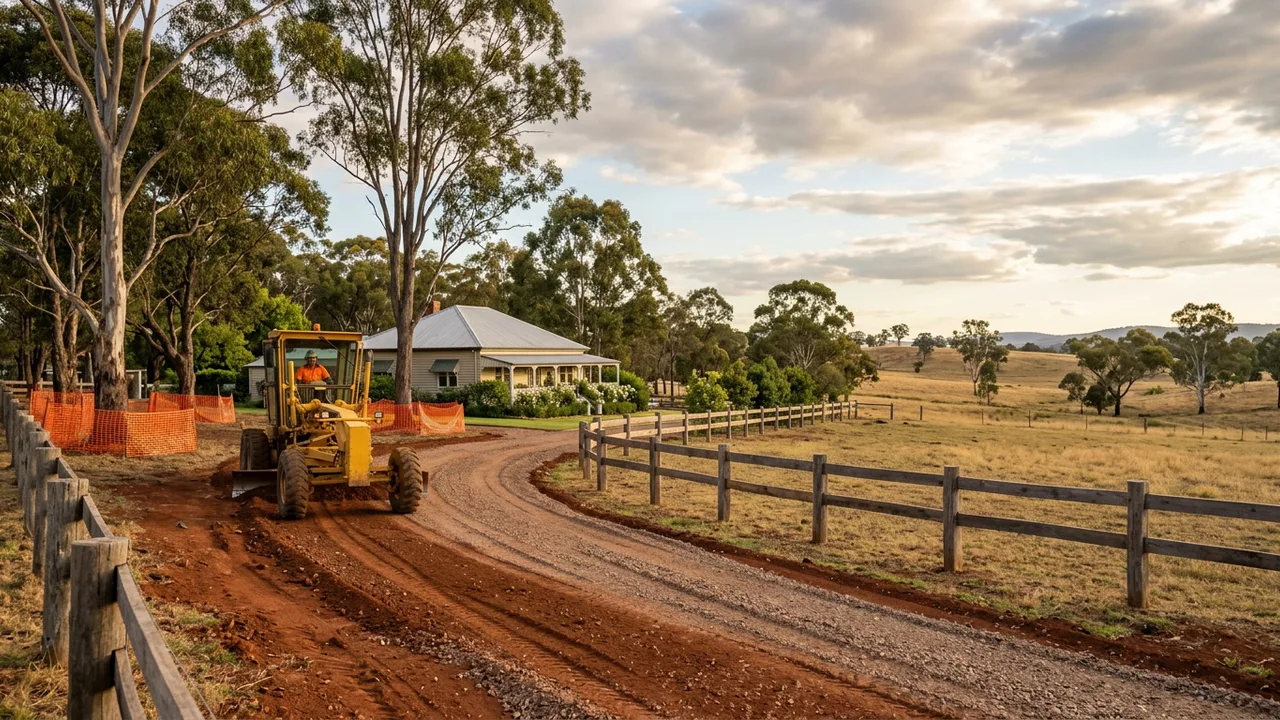
Earthworks in Cranley for Acreage and Home Blocks
No flat spot for the shed, a house pad to cut, or a long driveway that washes out? A local earthmoving contractor prices the whole job in writing.
Earthworks on a Cranley block start with a walk of the ground. Before pricing, the contractor sees which way the land falls and where a float can get in, because on acreage that decides how much cut and fill the pad needs. The usual order is strip the topsoil, cut and fill, then compact and grade, and getting that order right keeps the slab crew on schedule.
Earthworks in Cranley, Toowoomba: shed pads, house pads and long driveways
On Cranley acreage the jobs start with what the block lacks: a flat spot to build on, a driveway that holds up in the wet, or a trench to carry water and power to a shed.
Every pad, driveway and trench starts the same way: shape the block so water runs away from where you build and the ground is even enough for the next stage. Skip it and the pad or driveway ends up holding water.
An independent earthmoving contractor who works around Toowoomba prices these jobs together. That saves you chasing a separate trade for each stage, and it lets the machines do the work in the right order.
Farm dam construction is a separate job from the pads, driveways and trenches around the house and shed. This work covers the second group.
Long driveways on a Cranley block
On acreage the driveway from the road to the house or shed is longer than on a suburban lot, so the way it sheds water matters more. Topsoil comes off the line of the driveway first, because soft, organic soil under a base breaks up under trucks.
The run is then shaped with a crossfall or a crown so rain leaves the surface, and table drains along the side carry it away instead of down the wheel tracks. A firm, compacted base goes down before any gravel or seal.
A driveway price covers the length of the run, the base material and where the surplus soil goes.
Trenching for water and power to a shed
A shed or a second dwelling on acreage needs water, power or drainage brought across the block, and that means a trench. The distances are longer than in town, so the route is set to avoid the pad, the driveway and any spot where water collects.
Before digging, the contractor finds out where underground pipes and cables already run, so they are located rather than found by the bucket. The trench is dug to the depth the plumber or electrician needs, then backfilled and compacted so it does not sink into a rut after rain.
Rock in the trench line can call for a bigger machine or a rock hammer, which slows the dig.
House pads and shed pads that are level before the slab crew arrives
A pad is a flat, compacted platform cut into the ground, and it has to be right before a slab can be poured. If the builder arrives and the pad is out of level or soft, the whole schedule slips. That is why the contractor sets levels carefully and compacts the fill in layers.
For a shed pad, the same method applies on a smaller scale. A shed ordered for delivery needs a flat spot with a firm base, and a slope often means cutting into the high side and filling the low side.
Access matters too. An excavator arrives on a float, a trailer that needs a gate and track wide enough to pass, plus room for trucks to bring or take away material.
What drives the price of earthworks in Cranley
The price follows machine hours, the volume of soil moved, how far it travels and what the ground turns out to hold. Rock, tight access and wet soil all add time. A flat, open block with easy truck access costs less to work than a steep, cluttered one.
The quote spells out whether rock is priced in or charged as it turns up, and where the spoil ends up. The QBCC register lets you look up the licence of a contractor before you agree to anything.
Shed pad on a slope or a driveway that turns to mud after rain? Say how far the gate is off Boundary Road, how the block falls and what you want to build.
Cranley ground, access and boundaries
Cranley is a rural and residential suburb on Toowoomba's northern edge, next to Wilsonton and Rockville. Small farms and low-density country-style lots make up most of the suburb, so there is often room to bring in an excavator or truck and turn it around. Long driveways and farm gates are worth measuring, because they decide which machine fits.
The older southern pocket of the suburb is mostly established detached houses. Work there tends to be smaller, like a shed pad or a trench, and tighter access can limit machine size.
Gowrie Creek roughly follows the northern and eastern boundary, so blocks out that way need a close look at where water goes after heavy rain before a pad or driveway position is settled. Blocks below the Cranley Escarpment can take runoff from upslope, so the same question applies there.
Boundary Road marks the western edge. Rural gates can be hard to find on a map, so say where yours sits off Boundary Road or how far it is from Cranley railway station.
Services in Cranley
- Swimming pool excavation Pool digs planned around machine access, rock and clay, with the spoil trucked off your property.
- Yard clean-up and spoil removal Leftover soil, rubble and spoil removed from the yard and carted off by tipper truck after the dig.
- House and shed pads Pads cut, filled and compacted to the levels your slab or shed needs, on suburban and rural blocks.
- Site preparation and levelling Topsoil stripping, rubble removal, cut and fill and grading take a block from rough ground to build-ready.
- Excavation and footings Footing and slab digs through local clay, rock and old fill, including blocks with tight side access.
- Driveway earthworks Driveways shaped, drained and laid with road base, gravel or bitumen so they stop washing out in storms.
- Retaining wall excavation The cut, set-out and drainage room behind concrete sleeper or sandstone block walls on sloping blocks.
- Trenching Trenches for stormwater, water and power dug to depth and line, with the yard around them left tidy.
Frequently Asked Questions
Who handles the earthworks if I subdivide my Cranley acreage?
Get it priced
Block not level or ground in the way of your build? Tell us about the job and get it moving.
Share the details and we will help you take the next step with confidence.