
Excavation Contractors in Toowoomba
Footings and slab areas dug through clay, rock and old fill, even down a narrow side path. Describe the block and get the ground ready for your builder.
Toowoomba excavation contractors cut the trenches and pad your slab sits in to the depths and widths your builder or engineer has set, often through awkward ground. Soft, open ground is quick work. Reactive clay, floaters of rock, buried fill or a side path barely wider than a wheelbarrow slow it down.
Excavation contractors in Toowoomba: footings, slabs and clay
A good excavation contractor digs to the plans, not to what is easy. For a house or shed, that means trenches and a slab area with a firm base and neat sides, at exactly the levels on the plans.
Clay makes that harder than it sounds. Toowoomba ground mixes reactive clay, shallow rock and sloping blocks, often on the same street. Clay swells when wet and cracks when dry, so an engineer may specify deeper or wider footings than you expect. Old fill that was never compacted and rock close to the surface can also turn up, and either one changes the dig.
Ground conditions change from one block to the next, so a look at your block tells far more than a price over the phone. An operator reads the ground as the bucket goes in.
What clay, rock and old fill do to a dig
Clay, rock and fill each change how long the dig takes and what machine suits it. Wet clay sticks to the bucket and turns trench floors to mud. Dry clay can be hard going and breaks away in lumps.
Rock may need a hydraulic hammer or a ripper tooth fitted to the excavator, and both add time. Old fill is the wildcard. It can hold bricks, concrete, timber or soft pockets that must be dug out and replaced so the footing does not sink later.
A test dig shows what the ground is doing. A soft pocket found mid-dig is usually priced as extra digging plus compacted backfill, brought back up to the builder's level.
Tight side access and the right excavator
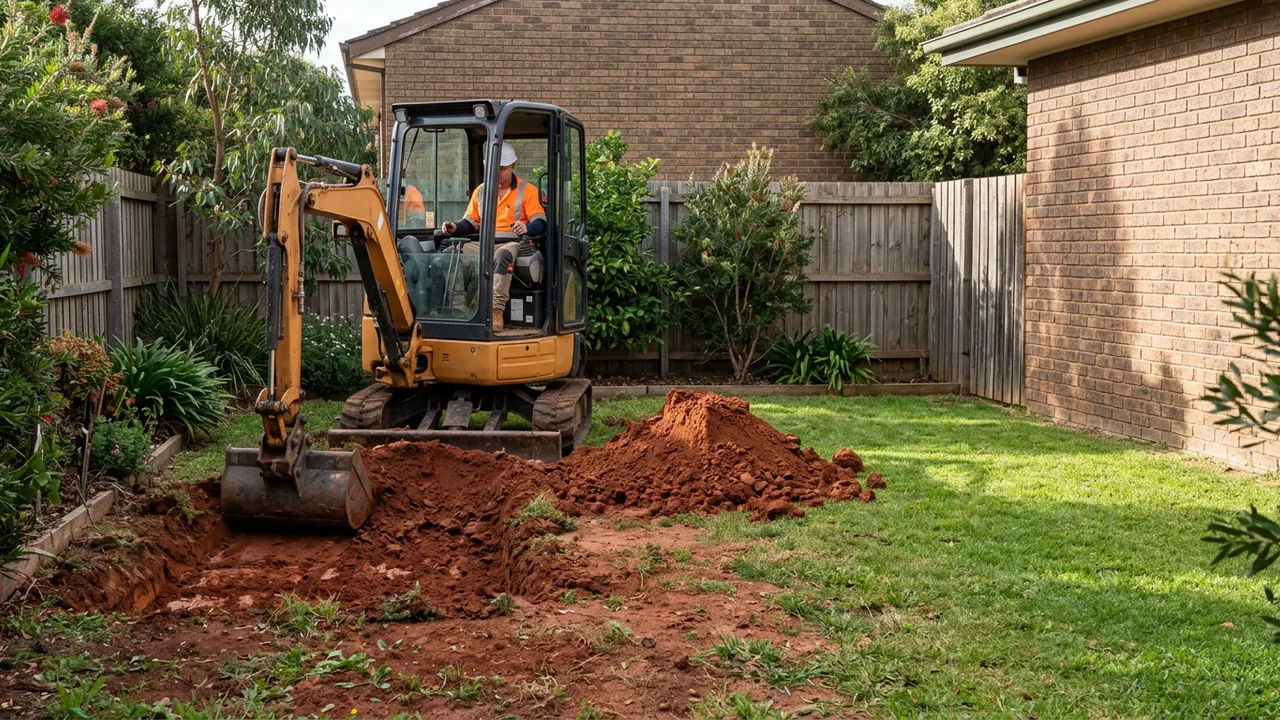
A narrow side path does not rule out a dig. Compact excavators are built to fit through gaps a standard machine cannot, and some can be driven or lifted into a backyard with care.
The trade-off is size. A compact machine digs less per hour and struggles in hard rock, so the same footings take longer. A standard machine is faster but needs open access. Fences, gates, trees, retaining walls and overhead power lines all affect which one can work and where it can stand.
Excavator hire by itself rarely suits a footing dig on a tight block, because the machine needs a trained operator who can work to the plans. If spoil cannot be trucked out the front, it may have to be carried out in small loads. That labour is part of the price, so access belongs in the conversation from the start.
What drives the price of an excavation
Four things move the price most: the volume of ground to be dug, how hard it is, how easily the machine reaches it and how far the spoil must travel. A sloping block adds another layer, because the pad may need cutting on one side and building up on the other.
On a footing dig, getting the spoil off site is often a large share of the work. Earthmovers who also run trucks can cart the spoil away in the same visit, so you deal with one crew rather than two.
Why digging to the builder's levels matters
Footings need exact depths and widths, and a trench cut too deep or too wide means extra concrete or a rework. A contractor who sets out from the plans and digs to the builder's levels carries that responsibility, so the builder can pour on the day booked.
Site preparation on sloping blocks
Removing rubble from the footprint first saves digging time. Old slabs, garden beds, old fencing and dumped rubbish all sit in the machine's way, and any of them can hide buried pipes.
On a block that falls away from the street or the back fence, the pad is usually cut into the high side and built up on the low side. The fall and the soil decide how much is cut and how much is filled, so the contractor reads both on site before the machine starts.
Grading the area to rough levels keeps the site workable. So does planning where rain will run during the dig, which stops trenches filling with water.
Licences for excavation work in Toowoomba
Excavation tied to building work can fall under Queensland's licensing rules, and categories and exemptions differ, so the position depends on the work. The QBCC register lets you look up a contractor's licence and history before you agree to anything.
Got reactive clay, a rock shelf or a narrow side path between you and your slab? Request a Project Review and say how the ground falls, how wide the side access is and what stands on the block now. The dig can then be priced on what is actually there.
How it works
-
Look at the block
The contractor checks the slope, the side access, what stands on the ground now and what the soil looks like.
-
Quote in writing
You receive a price for the dig that sets out the agreed scope before a machine comes through the gate.
-
Set out and dig
The operator marks the footprint from the plans, then cuts the trenches or pad to the levels the builder needs.
-
Cart away the spoil
Surplus soil and rubble is loaded out, leaving the site ready for the next trade.
Scope in detail
- Footing and beam trenches The trench has to reach the depth and width on the plans, with clean sides and a level base, or the builder cannot pour.
- Slab and pad excavation The whole footprint is cut to a set level so the slab has an even bed under it.
- Rock and old fill Rock close to the surface may need a hammer or ripper, and buried fill is dug out until the base is firm. A test dig with the excavator shows which one you have.
- Spoil removal The dirt that comes out of the trench has to go somewhere, and carting it off keeps the yard usable.
Excavation and footings options
- Compact excavator digs A small machine that fits through narrow gates and side paths, suited to house and shed footings in a backyard.
- Standard excavator digs A larger machine that digs faster and handles harder ground when the front or side access is open.
Excavation and footings across Toowoomba
Frequently Asked Questions
Is my Toowoomba excavation contractor licensed and insured?
What licence and tickets should an excavation contractor in Toowoomba be able to show?
Does excavation for building work need a QBCC-licensed contractor?
Get it priced
Block not level or ground in the way of your build? Tell us about the job and get it moving.
Share the details and we will help you take the next step with confidence.